
Last updated August 22, 2026 · Editorially reviewed by CanzarTV
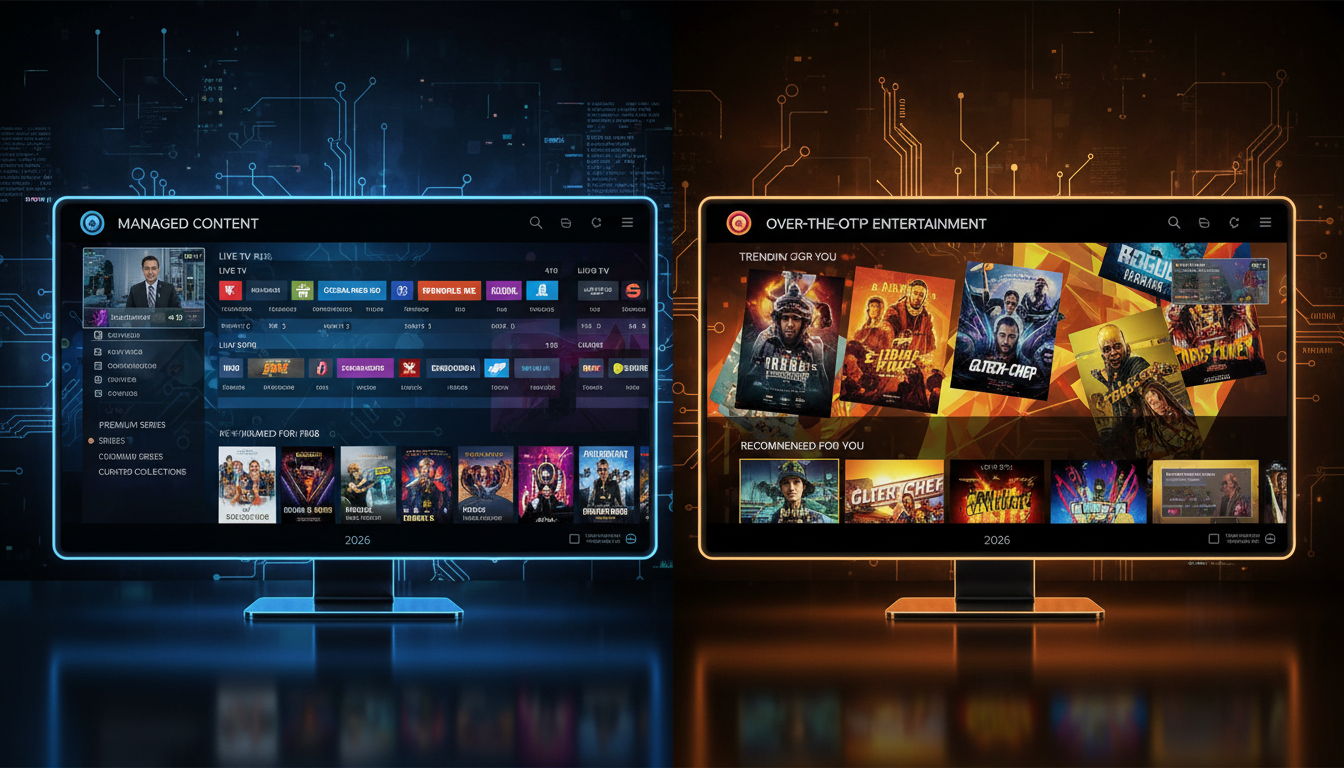
IPTV vs. OTT: What’s the Difference in 2026?
As streaming technologies mature, the lines between delivery methods blur—but important technical, business, and user-experience differences remain. In this article we explain IPTV vs. OTT: What’s the Difference in 2026? in clear, practical terms so you can understand performance, deployment trade-offs, monetization options, and what to expect from suppliers like CanzarTV.
High-level definitions
IPTV (Internet Protocol Television) refers to video services delivered over a managed or operator-controlled IP network—commonly the broadband network of an ISP or a dedicated multicast-enabled domain. IPTV often uses set-top boxes, operator middleware, and a managed service model with SLAs for bandwidth and quality.
OTT (Over-The-Top) refers to video delivered over the public internet—over-the-top of network operators—using standard web protocols and CDNs. OTT services are accessible on smart TVs, mobile devices, web browsers, and streaming devices without requiring operator provisioning.
Key technical differences in 2026
Network architecture and delivery
- IPTV: Delivered over a managed network using multicast (RTP/UDP) for linear channels and unicast for VOD. Operators rely on IGMPv2/IGMPv3, PIM for multicast, and QoS mechanisms on MPLS or carrier-grade broadband.
- OTT: Delivered over the public internet in unicast using HTTP adaptive bitrate protocols (HLS, MPEG-DASH) with CMAF packaging. In 2026, HTTP/3 (QUIC) is widely adopted across CDNs to reduce connection overhead and improve resilience.
Latency and streaming modes
- Latency (live): IPTV on managed networks typically achieves very low end-to-end latency—often under 2–5 seconds—because multicast avoids per-client transcoding and benefits from operator timing control.
- OTT latency: Historically higher (20–30s for classic HLS), but by 2026 widespread adoption of LL-HLS/LL-DASH, WebRTC-based solutions, and chunked CMAF + HTTP/3 has reduced typical OTT live latency to 2–5 seconds for many premium deployments, with sub-second achievable via WebRTC for interactive use-cases.
Codec, packaging, and transport trends
- Modern codecs: HEVC and AV1 are mainstream; VVC (H.266) is available for high-end 8K and premium 4K tiers where licensing allows. AV1 adoption has accelerated for OTT because of royalty-friendly licensing in many implementations.
- Packaging: CMAF unifies packaging for HLS and DASH and supports chunked transfer for low-latency streaming.
- Transport: HTTP/3 (QUIC) and TLS 1.3 dominate OTT stacks for lower buffering and better mobile performance.
Quality, control, and reliability
Quality of Service (QoS) and Service Level Agreements
IPTV services are typically backed by SLAs from the operator—guaranteed bandwidth, prioritized traffic, and proactive network management. That makes IPTV the preferred choice where consistent QoE is critical (e.g., hospitality, multi-dwelling units, enterprise deployments).
OTT relies on CDNs and the best-effort public internet. Providers mitigate variability with:
- Multi-CDN architectures
- Edge computing and regional PoPs
- ABR (adaptive bitrate) algorithms tuned with ML
- Real-time QoE telemetry and automated route selection
Security and rights management
Both IPTV and OTT use robust DRM systems in 2026—Widevine, PlayReady, and FairPlay are standard plus interoperable DRM wrappers for CMAF. For piracy mitigation, forensic watermarking and tokenized authentication are common across both delivery types. OTT emphasizes cloud-based entitlement and API-driven authentication, while IPTV integrates with operator OSS/BSS for subscriber provisioning.
Business models and monetization
- IPTV: Often sold as part of ISP bundles (triple-play), enterprise packages, or closed ecosystems with curated channel lineups and operator billing. Bundling and upstream/network-level advertising are common.
- OTT: Supports SVOD, AVOD, FAST channels, TVOD, and hybrid models. Dynamic ad insertion (server-side and client-side), addressable ads, and programmatic advertising are mature, enabling fine-grained monetization and measurement.
Device compatibility and user experience
OTT has broader device reach—smart TVs, mobile apps, browsers, and streaming sticks. IPTV relies on certified set-top boxes or operator-certified apps on specific smart TV platforms. However, by 2026 many operators offer companion OTT apps to extend reach beyond the managed network.
Personalization and AI
AI-driven recommendations, personalized UX, and real-time content stitching are now standard for OTT. IPTV platforms incorporate the same personalization features but often combine them with network-aware optimizations (e.g., prefetching VOD assets during off-peak windows to improve startup times).
Which is right for you?
Choosing between IPTV and OTT depends on priorities:
- Choose IPTV if you need guaranteed QoS, low latency for live linear channels, integrated billing, or a closed ecosystem for a hospitality/enterprise environment.
- Choose OTT if you need the broadest device reach, rapid feature rollout, flexible monetization (SVOD/AVOD/FAST), and a cloud-native infrastructure with global scale.
- Hybrid approaches are increasingly common: managed IPTV for linear/sports and OTT for on-demand, with seamless authentication between them.
Practical tips for consumers and businesses in 2026
- For sports/freedom-from-lag: verify live latency numbers (startup and end-to-end delay) and look for LL-HLS or operator multicast for critical events.
- For consistent quality in multi-user households: prefer ISP-bundled IPTV or ensure your ISP supports traffic prioritization for streaming devices.
- For global audiences: use multi-CDN OTT with HTTP/3 and adaptive bitrate streaming; deploy regional edge logic to comply with licensing and reduce latency.
- For security: insist on modern DRM and forensic watermarking to protect rights and reduce piracy-related revenue loss.
Conclusion
In 2026, the core distinction of IPTV vs. OTT: What’s the Difference in 2026? remains rooted in network control and delivery model: IPTV is a managed, multicast-enabled service with operator-level guarantees; OTT is a flexible, CDN-backed web-native model optimized for scale and device reach. Advances like CMAF, HTTP/3, LL-HLS, and edge compute have narrowed some technical gaps—especially latency—making hybrid, use-case-driven deployments the norm.
If you want a reliable, modern streaming experience that combines low-latency live channels with a rich OTT-style on-demand library, consider how CanzarTV designs its services to leverage the best of both worlds.
Call to Action: To explore tailored streaming options and subscription plans, please check out CanzarTV’s subscription plans and see which package fits your viewing needs.

Canzar
Ready to stream? Pick your plan
Live TV, movies, sports and 10,000+ channels on any device — Firestick, Android TV, Smart TV, phone.
View Subscription Plans Compare Pricing
Moderation: Comments are reviewed before publishing. Be respectful and on-topic.
Guidelines: Share streaming tips, device help, or content recommendations. No spam, no promotions, no off-topic links.