
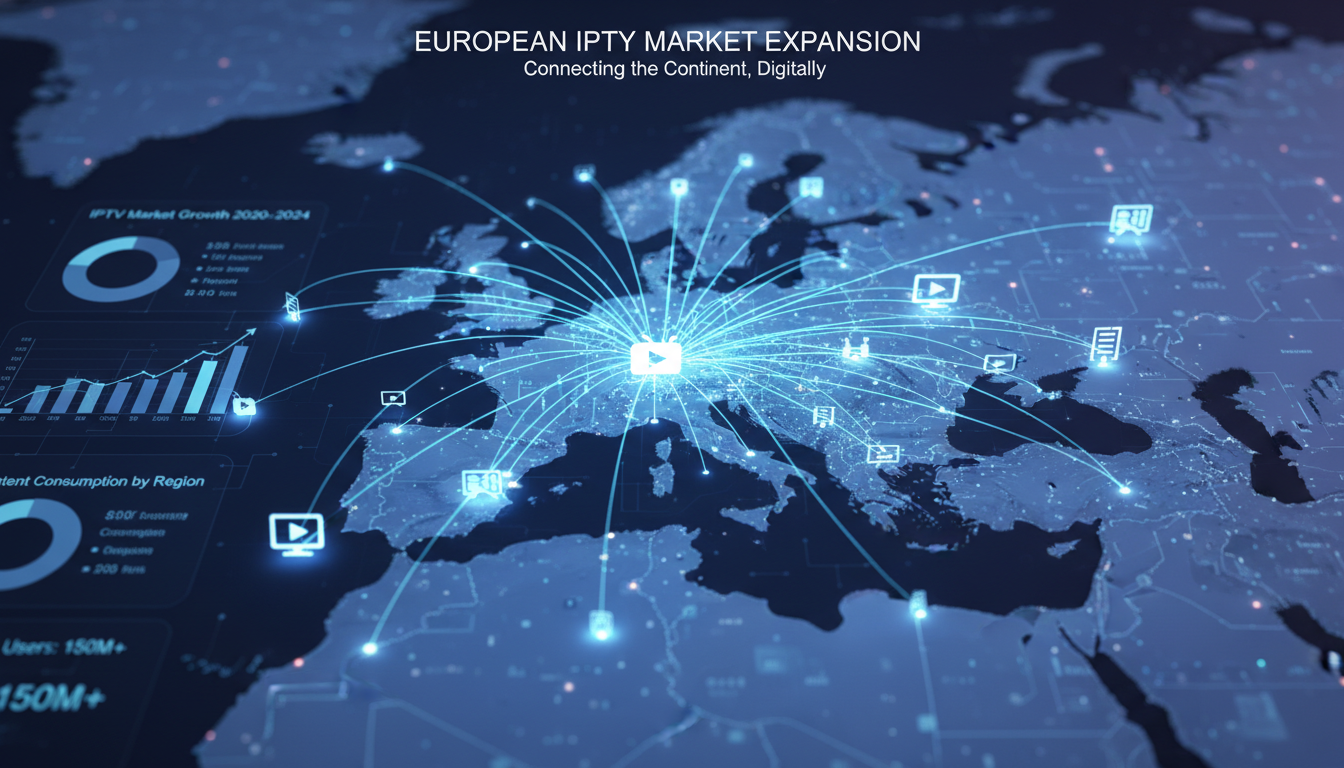
Last updated August 22, 2026 · Editorially reviewed by CanzarTV

Europe’s IPTV Market: Growth and Challenges in 2026
The landscape for IPTV in Europe continues to evolve rapidly in 2026. As broadband ubiquity, 5G rollout, advanced edge infrastructure and new streaming standards converge, IPTV services are both expanding their reach and facing complex technical, regulatory and commercial headwinds. This article reviews the key drivers behind the market’s growth, the primary technical and non-technical challenges providers face, and practical approaches operators can adopt to succeed in this competitive environment.
Market Overview: Why Europe’s IPTV Market Grows in 2026
Several structural trends support ongoing expansion of IPTV across European markets:
- Broadband and 5G penetration: Fiber-to-the-home (FTTH) and fixed wireless (5G) coverage have lowered barriers to high-bitrate video delivery in suburban and many rural regions.
- Smart TV and device proliferation: Modern smart TVs, Android TV, Tizen, webOS and streaming boxes make IPTV apps widely accessible without bespoke hardware.
- Hybrid content models: Growth of FAST, AVOD and subscription bundles allow providers to mix revenue streams and lower price friction for consumers.
- Regionalization and local content: Demand for local-language channels, sports rights and regional entertainment supports differentiated IPTV offerings that global OTT players can’t fully replicate.
Europe’s IPTV Market: Growth and Challenges in 2026 is therefore a story of opportunity—rising addressable audiences—but also a story of complexity: the technical stack and business models required to compete are more demanding than ever.
Technical Evolution: Core Enablers for Modern IPTV
Delivery and streaming protocols
By 2026, most competitive IPTV operators leverage a layered approach to delivery:
- Origin & contribution: SRT and RIST are common for reliable live contribution from production sites to origin servers.
- Distribution: CMAF-based ABR (Adaptive Bitrate) packaging with HLS and DASH remains the standard for client compatibility, while LL‑HLS and low-latency CMAF solutions are used for time-sensitive events.
- Edge delivery: Multi-CDN strategies and CDN PoP presence—augmented with edge compute for personalization and ad stitching—are essential to maintain consistent Quality of Experience (QoE).
Codecs, latency and device compatibility
Efficient codecs (AV1 and HEVC for many premium channels; still H.264 for broad compatibility) are in active use. The trade-off between compression efficiency and device decoding capability is managed through selective transcode ladders and device detection. Low-latency streaming targets sub-3 second glass-to-glass latency for most content; sub-1 second remains niche, used primarily for interactive and betting applications.
DRM, watermarking and security
Content protection is a baseline requirement. Common practices include:
- Widevine, PlayReady and FairPlay DRM support across clients.
- Forensic watermarking (real-time and forensic trace) to deter and trace piracy.
- Token-based authentication, OAuth and short-lived session tokens to reduce account sharing and credential misuse.
Regulatory and Commercial Challenges
Content rights and cross-border licensing
One of the biggest commercial obstacles remains fragmented licensing. Rights negotiation across European territories is complex—rights windows, language requirements and sports exclusivity all constrain how providers can scale pan‑European packages. Providers must invest in rights management systems and legal expertise to support multi-territory offerings.
Privacy, data protection and platform governance
GDPR is fully embedded into operational compliance, and new EU frameworks—like the Digital Markets Act (DMA) and evolving ePrivacy rules—affect tracking, targeted advertising and interoperability. IPTV operators must:
- Adopt privacy‑first telemetry and consent management platforms.
- Offer clear opt-in/opt-out for personalized ads and data sharing.
- Plan for platform openness where DMA designations apply (if relevant to business scale).
Piracy and enforcement
Piracy remains an ongoing threat. While watermarking, legal takedowns and ISP cooperation reduce casual theft, more sophisticated bot farms and illicit aggregators require layered defenses and active monitoring. Collaboration with industry coalitions and rapid takedown workflows remain necessary elements of an anti-piracy strategy.
Consumer Trends, UX and Monetization
Changing customer expectations
Users expect:
- Seamless multi-device continuity (start on TV, resume on mobile).
- Fast channel zapping and low startup times.
- Personalized recommendations while respecting privacy choices.
Meeting these expectations often requires investing in modern middleware, indexed content catalogs and client-side optimizations—things that separate successful providers from marginal ones.
Monetization strategies
Successful IPTV operators mix revenue approaches:
- Subscription (SVOD): Core long-term revenue source for premium content.
- Ad-supported (AVOD/FAST): Lowers entry barriers and supports scale, but requires strong ad infrastructure and privacy-compliant targeting.
- Transactional (TVOD): Useful for PPV sports and special events.
- Bundling & wholesale: Carrier partnerships and white-label distribution can expand reach with lower customer acquisition cost (CAC).
Operational Best Practices for IPTV Providers
To thrive in Europe’s 2026 IPTV market, operators should adopt these practical measures:
- Multi‑CDN and edge compute: Use multi‑CDN with intelligent routing and edge logic for SSAI and personalization to control latency and resilience.
- Extensive telemetry & QoE monitoring: Instrument player and network telemetry to measure MOS, startup time, rebuffering and adapt bitrate ladders dynamically.
- Robust rights & subscription management: Centralize entitlement checks, geo‑rules and device limits to accelerate new territory launches.
- Privacy-by-design: Implement consent frameworks and minimize retention of personal data while maintaining actionable analytics through anonymization and aggregate signals.
- Anti-piracy posture: Combine watermarking, forensic analytics and automated detection with legal enforcement and ISP cooperation.
Conclusion
Europe’s IPTV Market: Growth and Challenges in 2026 captures a sector at once promising and demanding. Technological advances—CMAF, low-latency streaming, edge compute, and improved codecs—enable higher-quality, more interactive services. But providers must navigate licensing complexity, privacy regulation, device fragmentation and persistent piracy. Operators that invest in performant delivery, strong rights management, privacy-aware personalization and multi-revenue models will be best positioned to grow.
At CanzarTV, we focus on delivering reliable, compliant and user-centric IPTV experiences—optimized for low-latency live events, multilanguage support and flexible monetization. If you’re evaluating options for a modern IPTV provider, please consider reviewing CanzarTV’s subscription plans to find a package that fits your home or business needs.
Call to action: Visit CanzarTV to compare subscription plans and learn how our platform balances performance, security and value for European viewers.

Canzar
Ready to stream? Pick your plan
Live TV, movies, sports and 10,000+ channels on any device — Firestick, Android TV, Smart TV, phone.
View Subscription Plans Compare Pricing
Moderation: Comments are reviewed before publishing. Be respectful and on-topic.
Guidelines: Share streaming tips, device help, or content recommendations. No spam, no promotions, no off-topic links.