
Last updated August 22, 2026 · Editorially reviewed by CanzarTV
The Rise of AI-Powered Personalization in IPTV Streaming
The Rise of AI-Powered Personalization in IPTV Streaming is not just a marketing slogan — it describes a rapid, measurable shift in how viewers discover, consume, and engage with video content. For providers like CanzarTV, AI-driven personalization is becoming the differentiator that increases time‑watched, reduces churn, and unlocks higher ad and subscription revenues. This article explains the key technologies, architecture patterns, metrics, and best practices that streaming operators should use in 2026 to deliver genuinely personalized IPTV experiences.
Why personalization matters now
Consumer expectations have evolved: viewers expect content to match their tastes, context, and attention span immediately. Traditional EPGs and static recommendations no longer suffice. **AI-powered personalization** enables:
- Faster discovery: viewers find relevant shows and clips within seconds.
- Higher engagement: personalized playlists and adaptive surfacing increase session length and retention.
- Monetization: better-targeted ads and personalized offers lift ARPU (average revenue per user).
- Operational efficiency: automation reduces manual curation and editorial costs.
Core AI technologies powering IPTV personalization
By 2026, the personalization stack combines a range of modern ML techniques and engineering practices. Key components include:
Recommendation models
- Neural collaborative filtering and deep factorization machines for long-term taste modeling.
- Session-based models (e.g., transformer-based architectures like SASRec variants) for immediate, short-term intent.
- Graph neural networks for modeling multi-relational data — content, users, device types, and social signals.
- Contrastive learning to create robust content and user embeddings from multimodal signals (video, audio, subtitles).
Contextual and sequential personalization
Context (time of day, device, network conditions, live vs. VOD) is critical. Modern systems use:
- Contextual multi-armed bandits and contextual RL to balance exploration and exploitation in real time.
- Online learning for immediate model updates based on user interactions (plays, scrubs, stops).
Multimodal content understanding
Content embeddings today are multimodal:
- Video embeddings from VideoCLIP-like models and spatio-temporal transformers for scene-level relevance.
- Audio embeddings for mood and event detection (crowd noise, cheering, commentary type).
- Speech-to-text, OCR, and subtitle analysis to extract metadata and entities for semantic matching.
LLMs and conversational personalization
Large language models are now used for:
- Natural language search and semantic query expansion.
- Generating personalized summaries, dynamic trailers, and viewer-friendly descriptions.
- Orchestrating recommendation pipelines by generating candidate lists and reranking logic via retrieval-augmented approaches.
Architecture and engineering patterns
Delivering scalable AI personalization requires a robust data and ML infrastructure. A typical architecture includes:
- Event ingestion layer: high-throughput streaming (Kafka, Pulsar) capturing plays, heartbeats, scrubs, and QoE signals.
- Feature store: fast, consistent access to real-time and historical features (Feast or proprietary alternatives).
- Model training & MLOps: reproducible pipelines (Kubeflow/Metaflow), continuous training, and experiment tracking.
- Model serving: low-latency endpoints using Triton, ONNX Runtime, or serverless inference for hybrid cloud/edge deployments.
- Edge personalization: on-device ranking and lightweight models via CoreML, TensorRT, or TVM to respect privacy and reduce latency.
Real-time vs batch trade-offs
Some personalization tasks need millisecond latency (home screen ranking), while others can be batched (offline taste profile recalculation). The recommended approach:
- Use hybrid pipelines: batch for heavy representation learning and real-time inference for immediate context using cached embeddings and feature updates.
- Adopt a feature freshness policy: critical features update in seconds; less critical features in hours.
Privacy, security, and ethics
Personalization must be balanced with user privacy and regulatory compliance.
- Data minimization: collect only necessary events and aggregate where possible.
- Federated learning: train personalization models on-device and send encrypted gradients to the server for aggregation.
- Differential privacy: add statistical noise to model updates to prevent re-identification in shared models.
- Explainability: provide transparent reasons for recommendations (e.g., “Recommended because you watched X”).
- Consent and opt-outs: clear controls for users to turn off personalized recommendations or targeted advertising.
Key metrics and experimentation
Measure personalization impact with both engagement and quality metrics:
- Engagement: click-through rate (CTR), watch time, session length, retention cohort metrics.
- Ranking quality: precision@k, recall@k, NDCG, MRR.
- QoE and usability: start-up time, rebuffering, bitrate switches.
- Business: subscription conversion rate, churn rate, ad CPM uplift.
Use rigorous A/B testing and sequential testing for online learning components and consider multi‑armed bandit or canary releases when rolling out new ranking models.
Practical personalization features for CanzarTV
Concrete features that CanzarTV can implement to showcase the advantages of AI-powered personalization:
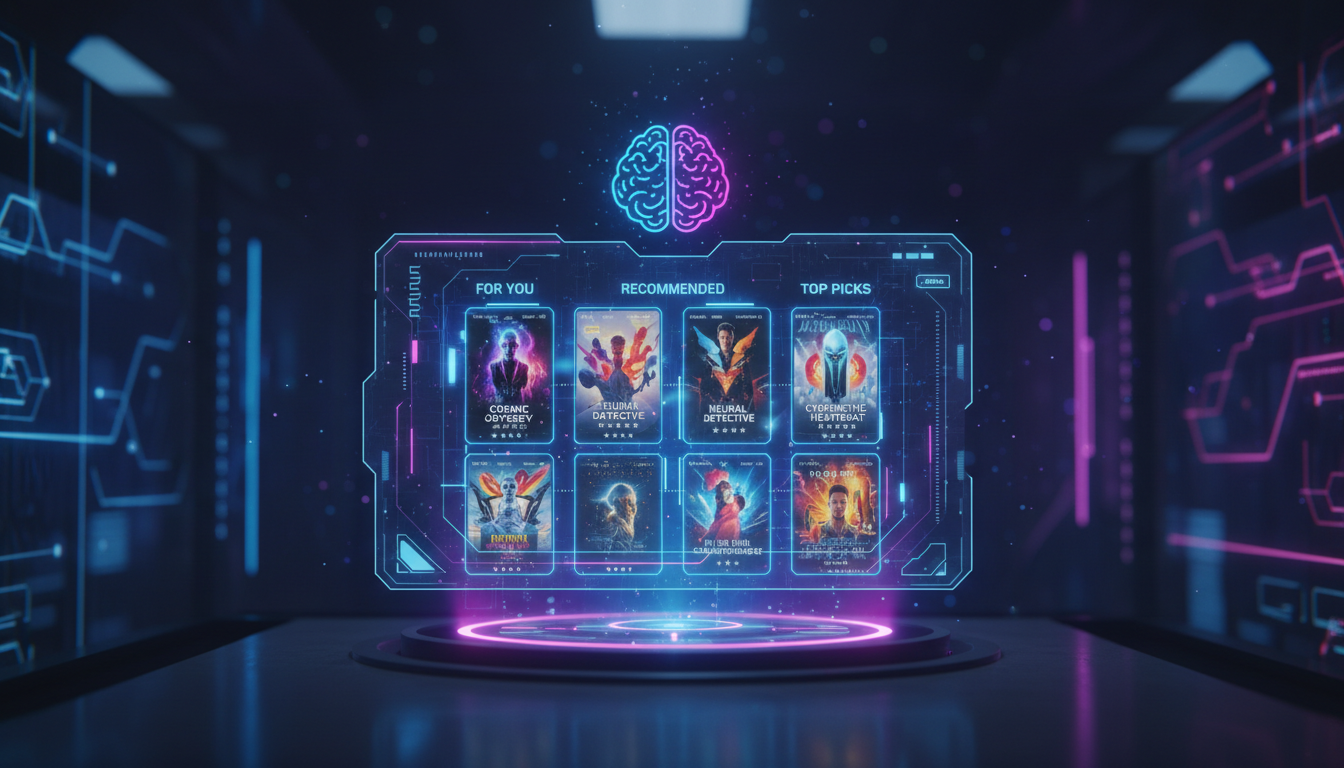
- Dynamic home screens: personalized carousels per profile and per device, updated in near real time.
- Personalized live TV channels: AI-curated channel lineups or “mini-channels” assembled from clips and matches tailored to a user’s interests.
- Adaptive trailers: auto-generated short trailers emphasizing scenes likely to convert a specific viewer.
- Smart resume and multi-device continuity: synchronized watch state and recommendations across devices with on-device rankers for speed.
- Sports personalization: multicam preferences, highlight reels prioritized by the teams/players a viewer follows.
- Kid mode and household profiles: content filters and engagement models tuned per profile with parental controls.
- Context-aware ads: server-side ad insertion with personalized ad selection while preserving privacy constraints.
Implementation roadmap and quick wins
Suggested incremental roadmap for a provider such as CanzarTV:
- Instrument events: ensure comprehensive event collection with a consistent schema.
- Deploy baseline recommenders: item-based collaborative filtering + simple popularity + recency signals.
- Introduce session models: add transformer-based session recommenders for immediate intent capture.
- Implement A/B frameworks: allow safe experimentation and automated rollback.
- Scale to multimodal embeddings: enrich catalog with video/audio/text embeddings for semantic matching.
- Edge personalization: move ranking for home-screen into the client for lower latency and privacy gains.
Final thoughts
The Rise of AI-Powered Personalization in IPTV Streaming represents a strategic opportunity: providers that architect for real-time, privacy-preserving personalization will win viewer attention and business outcomes. The right combination of models, data engineering, and ethical guardrails ensures recommendations are both effective and trustworthy.
Ready to experience smarter TV? Check out CanzarTV’s subscription plans to see how our AI-driven IPTV service personalizes viewing for every profile, device, and mood.

Canzar
Ready to stream? Pick your plan
Live TV, movies, sports and 10,000+ channels on any device — Firestick, Android TV, Smart TV, phone.
View Subscription Plans Compare Pricing
Moderation: Comments are reviewed before publishing. Be respectful and on-topic.
Guidelines: Share streaming tips, device help, or content recommendations. No spam, no promotions, no off-topic links.